Inside This Month’s SAA Insider: Are Recruiting ID Camps Actually Worth It?
One of the biggest questions families ask during the athletic recruiting process is also one of the hardest to answer:
Is this camp actually worth it?
Every year, student-athletes receive invitations to ID camps, prospect camps, showcases, elite camps, exposure events, and school-specific recruiting opportunities. Some of those events can be incredibly valuable. Some are useful, but only for the right athlete in the right situation. Others are expensive, time-consuming, and unlikely to move the recruiting process forward.
That is exactly what we’re covering in this month’s SAA Insider Membership Newsletter.
SAA Insider members will receive this video in their inbox on July 15th. Each month, members receive access to practical recruiting education designed specifically for counselors and advisors who work with student-athletes. This month’s featured video is a recap of our IECA Baltimore presentation, Are Athletic Camps Valuable in Recruiting?
The goal of the video is simple: help counselors better understand how camps actually work, what coaches are looking for, and how to help families decide whether a camp invitation is a real opportunity or just another expensive stop on the recruiting road.
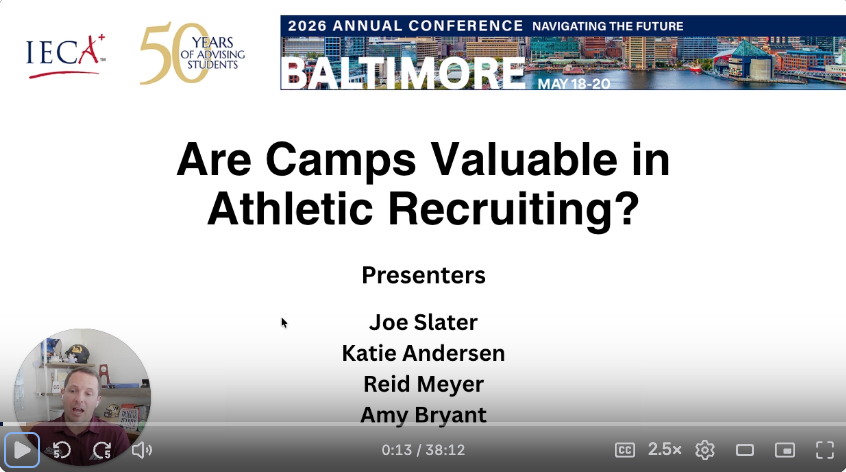
What the Video Covers
In the full member video, we start by breaking down the different types of camps families are likely to encounter.
The first category is development camps. These are usually geared toward younger athletes or athletes who are looking to improve their skills. They may be run by college coaches and can provide great instruction, but they are not always designed to be true recruiting events.
The second category is mass exposure camps. These events bring together a large number of athletes and a large number of college coaches. For some students, they can be efficient. Instead of traveling to six different campuses, a student may be able to get in front of many coaches in one location.
The third category is targeted exposure camps. These are usually tied to a specific college or small group of colleges. They tend to be most valuable when the student has already been communicating with that coaching staff and wants one more opportunity to be evaluated in person.
That distinction matters because families often hear the word “camp” and assume every event has the same recruiting value. It doesn’t.
Who Is Running the Camp?
Another major topic in the video is the difference between a college-run camp and a third-party camp.
A college-run camp is usually organized by the coaching staff at that school. Those coaches have their name on the event. They are usually more invested in how it runs and who attends.
A third-party camp is different. These events are run by outside companies that hire college coaches to attend. Some of these events are reputable and useful. Others are more hit or miss. Families need to look closely at which coaches are actually attending, whether those coaches are actively recruiting, and whether the event makes sense for that particular athlete.
This is one of the places where counselors can really help families slow down.
A list of college logos on a camp website does not always mean those programs are seriously evaluating every athlete in attendance.
What Coaches Get Out of Camps
The video also explains why camps are valuable from the college coach’s perspective.
Coaches are busy. They are running practices, managing current athletes, answering emails, dealing with compliance, planning travel, handling administrative work, and trying to recruit future classes at the same time.
Camps help coaches solve a few problems.
They allow coaches to bring athletes to them instead of traveling all over the country. They give coaches a chance to evaluate players in person. They help coaches measure a student’s real interest in the program. And, in many sports and divisions, camps can also be an important source of income for coaches.
That last part can be uncomfortable for families to hear, but it matters.
Not every camp invitation is a pure recruiting signal. Sometimes it means the coach is interested. Sometimes it means the camp needs more players. Sometimes it means both.
The Big Question: Prospect or Camp Filler?
The central framework in this month’s video is what we call the real prospect vs. camp filler test.
At many camps, there are a small number of athletes the coaching staff is truly focused on. These may be students the coaches have already watched, spoken with, researched, or invited personally.
Then there are other athletes who help make the camp work. They fill teams. They create competition. They allow the top prospects to be evaluated in drills, scrimmages, games, matches, races, or other competitive settings.
That does not mean those students are being treated badly. It just means families need to understand the difference between being invited to attend and being actively recruited.
So how can families tell?
A few signs usually matter.
Has the coach communicated personally with the athlete?
Has the coach said something specific about the athlete’s ability, video, position, academic profile, or recruiting fit?
Has the coach been willing to schedule a phone call?
Does the athlete match the level of the current roster?
Does the program appear to have a need in that athlete’s class, position, or event?
And one of the best tests we discuss in the video is this:
Would the coach know the athlete’s name when they walked into camp?
If the coach would walk up, shake the student’s hand, and say, “We’re excited to have you here,” that is a very different situation than a student arriving cold and hoping to get noticed.
The Case Studies
The full video also walks through several case studies to show how these decisions play out in real life.
We look at a rower who receives a camp invitation but falls below the program’s typical recruiting standards.
We discuss a volleyball player choosing between multiple school-specific camps with a limited family budget.
We cover a high-academic soccer player from California considering an East Coast exposure camp with strong academic D1 and D3 programs.
We look at a track athlete who is slightly off a school’s recruiting marks but has had multiple conversations with the event coach.
We talk through a “shoot your shot” situation, where a student may not be a realistic athletic recruit but has the financial flexibility and personal connection to make the camp worth attending anyway.
And we discuss a hockey player with serious Ivy League interest, but a major financial mismatch that needs to be addressed before the family invests more time, money, and emotion into the opportunity.
These examples are important because camp decisions are rarely simple. A camp can be a great idea for one student and a poor use of time and money for another.
The difference is context.
Why This Matters
For counselors, this is one of those areas where a little knowledge can make a big difference.
Families can feel a lot of pressure when a coach sends a camp invitation. They may worry that saying no means closing a door. They may assume that a big-name school invitation means serious recruiting interest. They may spend thousands of dollars chasing events that were never likely to lead anywhere.
The job of the counselor is not to make the decision for the family.
The job is to help them ask better questions.
Is this school a real fit?
Has there been meaningful communication?
Is the family comfortable with the cost?
Does the student match the program’s recruiting level?
Is this a true evaluation opportunity, or is the student likely filling out the camp?
What would need to happen after the camp for this to be considered successful?
Those questions help families make clearer, calmer decisions.
Want Access to the Full Video?
This video is available inside this month’s SAA Insider Membership Newsletter.
If you’d like access to the full video, along with more counselor-focused recruiting education, case studies, sport-specific resources, advising tools, and monthly updates, we’d love to have you join us.
The SAA Membership is designed to help counselors support student-athletes with more clarity and confidence, whether you’re advising one recruited athlete a year or working with them regularly.
Become an SAA Member today to access this month’s Insider video and the full library of member resources.
What You Get with the SAA Membership
The SAA Membership is built for counselors who want to feel more confident advising student-athletes without having to become full-time recruiting experts overnight.
Members get access to ongoing resources, trainings, and support around the real questions that come up in athletic recruiting. That includes monthly Insider videos, recruiting case studies, sport-specific guidance, counselor-facing tools, practical advising frameworks, and opportunities to ask questions about the situations you’re seeing with your own students.
Our focus is not on turning counselors into college coaches.
It is on helping counselors ask better questions, recognize common recruiting patterns, and guide families through a process that can feel confusing, emotional, and expensive.
This month’s video on recruiting camps is a great example of that work.