

Sports Medicine Careers for Student-Athletes
Many high school student-athletes love sports, science, fitness, and helping others, which naturally leads them to explore careers connected to sports medicine. What many students quickly discover, however, is that “sports medicine” is not one single profession. Instead, it is a broad field that includes careers focused on athletic performance, injury rehabilitation, and medical care.
For college student-athletes, these careers can feel especially meaningful because athletes already spend so much time around training rooms, strength coaches, rehabilitation specialists, and team medical staff. Many athletes become interested in these professions because of their own experiences with injuries, recovery, performance training, or the relationships they develop with healthcare professionals during their athletic careers.
At the same time, sports medicine-related careers often require demanding academic pathways, graduate school, clinical hours, and extensive time commitments. This can create challenges for student-athletes who are already balancing practices, travel, competitions, film sessions, lifting, and recovery.
Understanding the different pathways within sports medicine can help students make more informed decisions about majors, recruiting fit, and long-term career goals.
The Performance Side of Sports Medicine
The performance side of sports medicine focuses on helping athletes improve strength, speed, conditioning, endurance, mobility, and overall athletic performance. These careers are often ideal for students who enjoy fitness, exercise science, biomechanics, and human performance.
Strength and Conditioning Coach
Strength and conditioning coaches work directly with athletes to improve athletic performance and reduce injury risk. They design training programs that focus on speed, power, explosiveness, endurance, mobility, and recovery. At the college and professional levels, strength coaches also play an important role in team culture, motivation, and accountability.
Most strength coaches major in fields such as exercise science, kinesiology, sports science, or human performance. A bachelor’s degree is typically the minimum requirement to enter the field, although many collegiate and professional programs prefer coaches who also earn a master’s degree. Many coaches pursue certifications such as the Certified Strength and Conditioning Specialist (CSCS) credential.
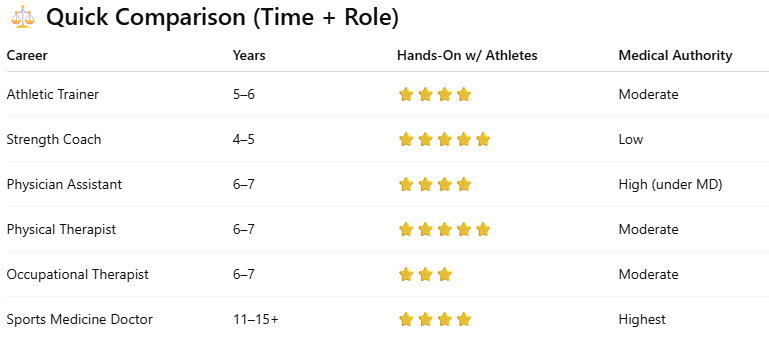
The educational pathway for strength coaches is generally shorter than that of many medical professions. Most students complete four years of undergraduate education, while some continue for an additional one to two years for graduate school. One challenge in this field is that entry-level positions can involve long hours, lower pay, and extensive travel before advancing to higher levels within college or professional athletics.
Exercise Physiologist
Exercise physiologists study how the body responds to exercise and physical activity. Some work directly with athletes, while others focus on cardiac rehabilitation, wellness programs, performance testing, and injury recovery. Their work may involve evaluating endurance, monitoring heart rate and oxygen usage, conducting stress testing, and developing individualized exercise programs.
Students interested in exercise physiology usually major in exercise science, kinesiology, biology, or human performance. Many exercise physiologists enter the workforce with a bachelor’s degree, although clinical and higher-level positions may prefer or require a master’s degree.
Most educational pathways include four years for a bachelor’s degree, with an additional one to two years possible for graduate education. Students who enjoy science, data, analytics, and human performance often find this career especially appealing.
The Rehab Side of Sports Medicine
The rehabilitation side of sports medicine focuses on helping athletes prevent injuries, recover from injuries, and safely return to activity. These careers are often highly hands-on and involve extensive interaction with patients and athletes.
Physical Therapist
Physical therapists help athletes and patients recover strength, mobility, and function following injuries or surgeries. They commonly work with ACL tears, shoulder injuries, stress fractures, back pain, post-surgical rehabilitation, and movement dysfunction.
For many former athletes, physical therapy is attractive because they personally experienced physical therapy during their own athletic careers. Physical therapists often build long-term relationships with patients and play a major role in helping athletes regain confidence after injuries.
Becoming a physical therapist requires significant education. Students first complete a bachelor’s degree, usually in exercise science, kinesiology, biology, or a related science field. After completing undergraduate prerequisites, students must apply to a Doctor of Physical Therapy (DPT) program, which typically lasts three additional years.
In total, the pathway to becoming a physical therapist is usually about seven years after high school. Students must also complete clinical rotations and pass licensing exams. Physical therapy programs are competitive, and student-athletes often face challenges balancing science labs, observation hours, and demanding athletic schedules.
Occupational Therapist
Occupational therapists help patients regain the ability to perform everyday activities following injuries, illnesses, disabilities, or neurological conditions. While occupational therapy is not always associated directly with athletics, OTs may work with concussion recovery, neurological rehabilitation, adaptive sports, or upper extremity injuries.
Occupational therapy can appeal to students who enjoy both science and problem-solving while also valuing creativity and patient interaction.
The pathway to becoming an occupational therapist generally includes a four-year bachelor’s degree followed by a master’s or doctoral occupational therapy program, which usually takes an additional two to three years. In total, most occupational therapists spend approximately six to seven years completing their education and clinical training.
Athletic Trainer
Athletic trainers are often the healthcare professionals student-athletes know best because they work directly with teams during practices and competitions. Athletic trainers evaluate injuries, provide emergency care, oversee rehabilitation programs, tape and brace athletes, and coordinate care with physicians and coaches.
One major change in recent years is that athletic training now generally requires a master’s degree for certification. Students usually complete a bachelor’s degree in exercise science, kinesiology, athletic training, or a related field before entering a master’s program in athletic training.
Most athletic trainers spend approximately six years completing their undergraduate and graduate education. They must also complete extensive clinical experiences and pass certification exams.
Athletic training can be a rewarding career for former athletes who enjoy team environments and daily interaction with athletes. However, the profession is also known for long hours, demanding schedules, nights and weekends, and extensive travel during sports seasons.
The Medical Side of Sports Medicine
The medical side of sports medicine focuses on diagnosing injuries, managing medical treatment, prescribing medications, performing procedures, and overseeing overall healthcare.
Physician Assistant (PA)
Physician assistants diagnose injuries, order imaging and tests, develop treatment plans, prescribe medications, and assist physicians in clinics and surgical settings. Many PAs specialize in orthopedics or sports medicine.
This pathway has become increasingly popular among student-athletes because it provides significant patient interaction and strong earning potential while requiring less schooling than medical school.
Students first complete a bachelor’s degree, often in biology, kinesiology, exercise science, or health sciences. They must then complete prerequisite science courses and accumulate clinical healthcare experience hours before applying to PA school. Physician assistant programs typically require an additional two to three years of graduate education.
In total, the PA pathway is usually six to seven years after high school. PA programs are highly competitive academically and often require strong science GPAs and extensive clinical experience.
Medical Doctor (MD or DO)
Sports medicine physicians diagnose and treat injuries and medical conditions in athletes and active individuals. Some specialize in orthopedic surgery, sports medicine, physical medicine and rehabilitation, or primary care sports medicine.
This is the longest and most academically demanding pathway within sports medicine. Students first complete a four-year bachelor’s degree with extensive science prerequisites. Medical school then requires four additional years. After medical school, physicians complete residency training, which may last three to seven years depending on specialty. Some physicians then complete an additional sports medicine fellowship.
The total pathway can range from eleven to fifteen years after high school before independent practice. While this route requires tremendous commitment, it can also be highly rewarding for students who are deeply passionate about medicine, science, and patient care.
Nurse
Nurses play a critical role in sports medicine and orthopedic care settings. They may work in hospitals, surgical centers, orthopedic clinics, rehabilitation facilities, sports medicine offices, or even college athletic departments.
For student-athletes, nursing can provide a strong balance of job stability, flexibility, earlier workforce entry, and opportunities for advancement into specialized healthcare roles.
There are several pathways into nursing. Some students pursue a Bachelor of Science in Nursing (BSN), which typically takes four years. Others may continue into advanced nursing roles through graduate education.
One challenge for student-athletes is that nursing programs often include strict clinical schedules, labs, and rotations that can conflict with athletic travel and practice schedules. Because of these demands, some coaches may hesitate to recruit athletes pursuing nursing unless the athletic department has experience supporting students in the program.
The Challenge of Balancing Sports Medicine Majors with College Athletics
One of the biggest realities student-athletes must understand is that many sports medicine-related majors are highly demanding. These programs often require science labs, internships, clinical rotations, observation hours, and tightly sequenced coursework that can be difficult to balance with athletics.
College athletes already manage:
Daily practices
Strength training
Team meetings
Recovery sessions
Film review
Competition travel
Missed class time
Adding a demanding healthcare or science curriculum on top of athletics requires strong time management, organization, communication skills, and support systems.
When evaluating colleges, student-athletes interested in sports medicine careers should ask thoughtful questions, including:
How supportive is the athletic department of demanding majors?
Have athletes successfully completed this major before?
Are labs and clinicals manageable with travel schedules?
Is summer coursework common?
Are professors flexible with athletic travel?
Does the school provide tutoring and academic support for athletes?
Finding the right balance between academics and athletics is often one of the most important parts of the college search process.
Key Takeaways for Student-Athletes
Sports medicine offers student-athletes an opportunity to combine their passion for athletics with meaningful careers focused on health, science, recovery, and human performance. However, the field includes many different pathways with very different educational timelines, lifestyles, and long-term commitments.
Some careers allow students to enter the workforce after four years of college, while others require graduate school, clinical training, or more than a decade of education.
The best path is not necessarily the most prestigious or highest paying. It is the path that aligns with a student’s strengths, interests, academic abilities, lifestyle goals, and willingness to commit to the educational process.
For many former student-athletes, the lessons learned through sports such as resilience, discipline, teamwork, communication, and leadership become some of the greatest strengths they bring into healthcare careers.